
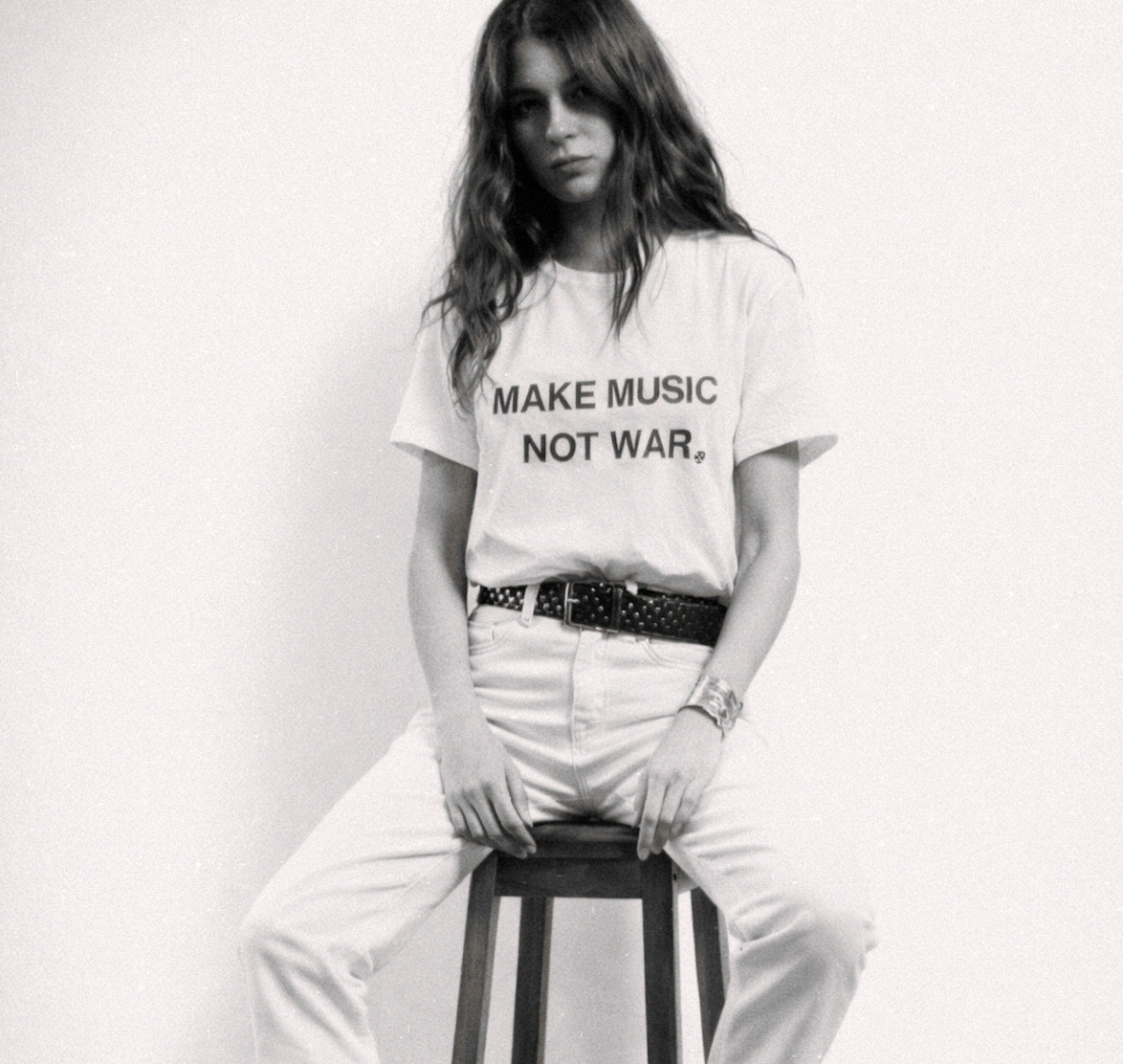
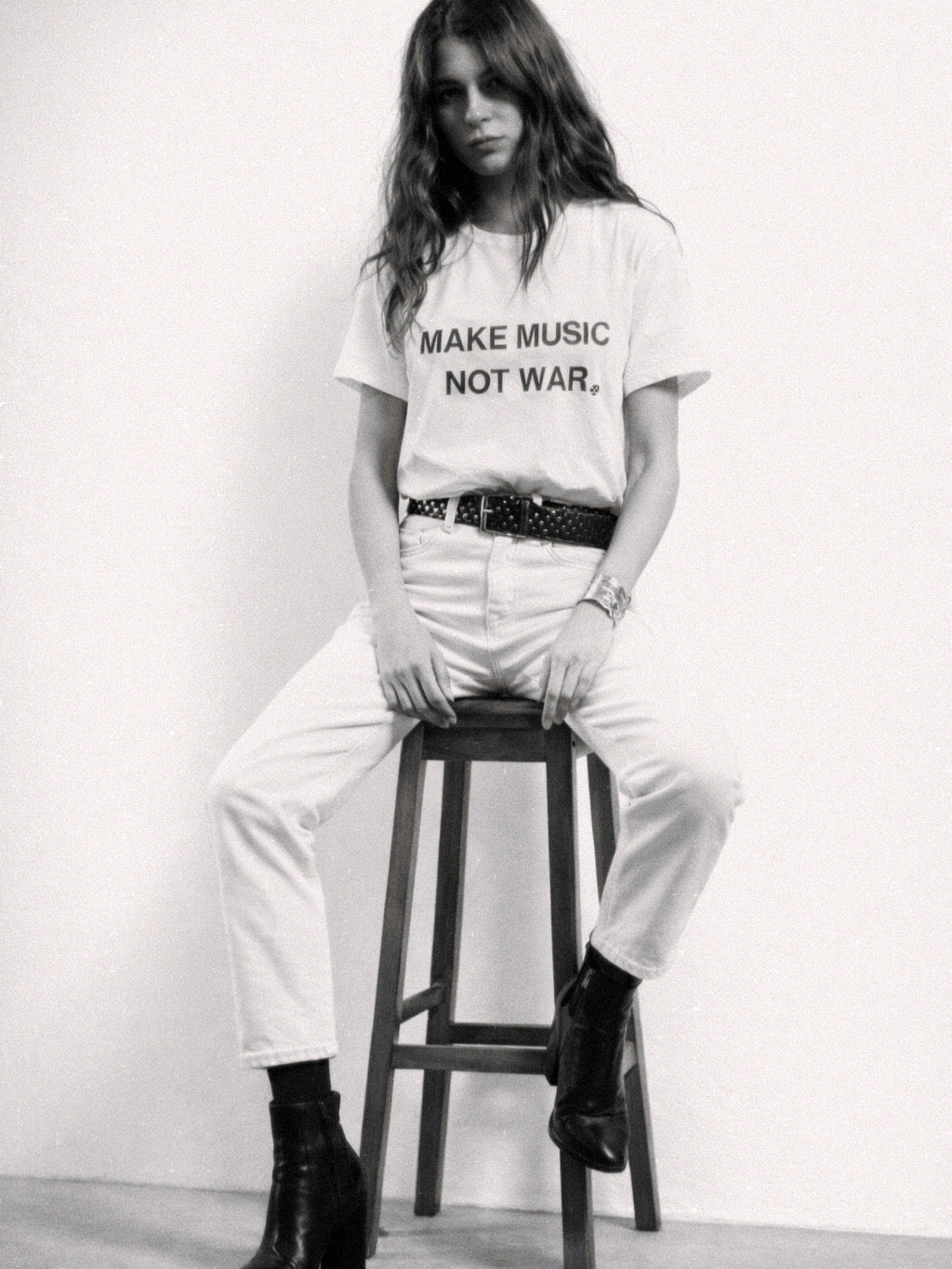

Limited Edition Impressed OVERSIZE TEE - IMPM006 WHITE 'MAKE MUSIC NOT WAR'
Why politicians fear musicians more than soldiers.
You can jail a body; you cannot jail a chorus once it has been memorised by millions.
There is a reason politicians fear musicians.
A melody is harder to silence than a headline.
You can jail a body; you cannot so easily jail a chorus once it has been memorised by millions. Music moves faster than policy. It slips through borders. It hums in the background of revolutions. It is sung softly in barracks and loudly in streets.
Long before press conferences and trending hashtags, there were songs carried on breath alone; passed from one body to another like contraband hope. Musicians have always spoken out against war not because they are naïve to its machinery, but because they understand its cost in a language that governments rarely do.
The language of the human heart breaking in real time.
In 1963, when Bob Dylan asked how many roads a man must walk down before you can call him a man, he wasn’t just writing a protest song — he was asking the country to look at itself in the mirror. A decade later, Marvin Gaye turned inward and upward at once on What’s Going On, building a cathedral of grief for brothers sent overseas and mothers left praying at kitchen tables. John Lennon’s US visa issues surely speak to a government concerned a melody can inspire more than a dancefloor.
When Lennon released ‘Give Peace a Chance’ in 1969, it barely resembled the polished recordings people expected from one of the most famous musicians on earth. Recorded during the now-legendary ‘Bed In’ protest he staged with Yoko Ono, the song sounded casual; a room full of voices repeating a phrase so simple it bordered on naive. But that simplicity was its power. Within months, crowds of protesters were singing it in unison, the chant echoing through demonstrations as if the act of repetition might make the idea itself real.
Lennon understood something essential about protest music, that the best of it doesn’t always argue. Sometimes it imagines.
Musicians in Australia have never needed permission to speak against war; they have simply done it, often at personal cost, often before it was fashionable, often from stages that smelled like beer and saltwater.
In the early 1980s, Midnight Oil weren’t just writing songs; they were issuing dispatches. “U.S. Forces” landed like a flare shot into the sky, illuminating Australia’s uneasy proximity to American militarism and Cold War anxiety. Peter Garrett’s body on stage, all limbs and urgency, felt like a warning system. The band understood something essential: that geography does not absolve a nation from moral entanglement. War, even when fought elsewhere, has fingerprints everywhere.
Before that, in smoky folk clubs, Redgum released ‘I Was Only 19’, a song so specific it felt like it could only belong to one returned soldier and yet it was so universal it became a communal elegy. It wasn’t a chant. It wasn’t a slogan. It was a story. And in telling that story, it quietly dismantled the mythology of glory that so often cloaks young men sent to fight. Its power was in its restraint.
Even bands not explicitly branded as protest acts carried anti-war sentiment in their marrow. The Saints, Eric Bogle and Radio Birdman emerged from a lineage that distrusted authority as a reflex. The refusal itself; the sneer, the distortion, the insistence on autonomy, was a posture against systems that demanded obedience without question. In a country still negotiating its identity between empire and independence, that mattered.
Later, artists like Paul Kelly folded political consciousness into songs that felt intimate. His writing has long understood that war is not an abstraction but something that lands in living rooms, that reshapes families, that lingers long after the news cycle moves on. Even Silverchair’s ‘Straight Lines,’ though not a war anthem outright, arrived in an era marked by global conflict and national anxiety - a reminder that survival itself can feel like protest.
And then there are the Indigenous Australian voices - artists like Warumpi Band, Ziggy Ramo, Tasman Keith and of course, Yothu Yindi - who expanded the conversation beyond foreign wars to the ongoing conflict at home. ‘Treaty’ was not about tanks or battlefields overseas, but it was about sovereignty, about the violence embedded in colonisation, about promises broken. To speak of war in Australia is to acknowledge that some of it has always been here.
What Australian musicians have done, time and again, is refuse the clean narrative. They have complicated the idea that war is noble, that alliance equals righteousness, that distance equals innocence. They have written from the vantage point of a country both implicated and peripheral, both participant and observer.
The Australian Anti-War protest song rarely sounds like a sermon. It often sounds like a pub chorus at closing time - ‘Khe Sanh’ by Cold Chisel has become one of the countries most enduring rock anthems - written about an Australian veteran returning home after the Vietnam War. Rather than describing combat, the lyrics focus on the emotional aftermath - the restlessness, the dislocation, and the feeling of not quite fitting back into civilian life. These songs often sound like dust kicked up on a regional highway. They sound like someone telling you the truth after the second drink, when the bravado drops. And that might be why they endure. Because they don’t ask you to chant. They ask you to listen.
And it’s well worth noting that ‘Khe Sanh’ was banned on the radio when it was released in 1978, which is testament to politicians fear of anti-war sentiment underlaying beats.
Musicians speak out against war because they understand what war interrupts: love stories, growing seasons, childhoods, the ordinary music of daily life. In Australia - as everywhere - the stage has often doubled as a pulpit, yes, but also as a mirror. And in that mirror, the nation has had to reckon with the cost of the battles it fights, and the ones it inherits.
And maybe that is the point. Musicians speak out against war because they are in the business of imagining otherwise. Every love song is, at its core, an argument for tenderness over domination. Every dance floor is a temporary ceasefire. To stand on a stage and insist that life - fragile, messy, radiant life - matters more than conquest is to wage a different kind of campaign altogether.
The protest song is not relic or genre.
It is a pulse.
It resurfaces whenever the world tips too far toward cruelty. And somewhere right now, someone is picking up an instrument not to escape the noise of war, but to answer it with something braver.
It’s with this sentiment, we are proud to announce our latest tee drop, ‘Make Music, Not War’.
Freedom To All Oppressed Peoples.
--
Made from 230gm 100% Cotton Jersey.
This run of tees have an oversized fit, please size down for a REGULAR fit and measure from the sizing chart pictured.
To get the longest life from your Impressed tee please gentle machine wash with cool or mild warm water, hang in the shade and iron inside out.
Please allow 3 business days for shipping.
Limited Edition Impressed OVERSIZE TEE - IMPM006 WHITE 'MAKE MUSIC NOT WAR'
Rad shirt, gets attention wherever I go.
It is a very oversized fit tho. The web site suggested to go size down but I could have happily gone down 2 or 3.
I got a large and it is bigger then some of my old 2XLs.